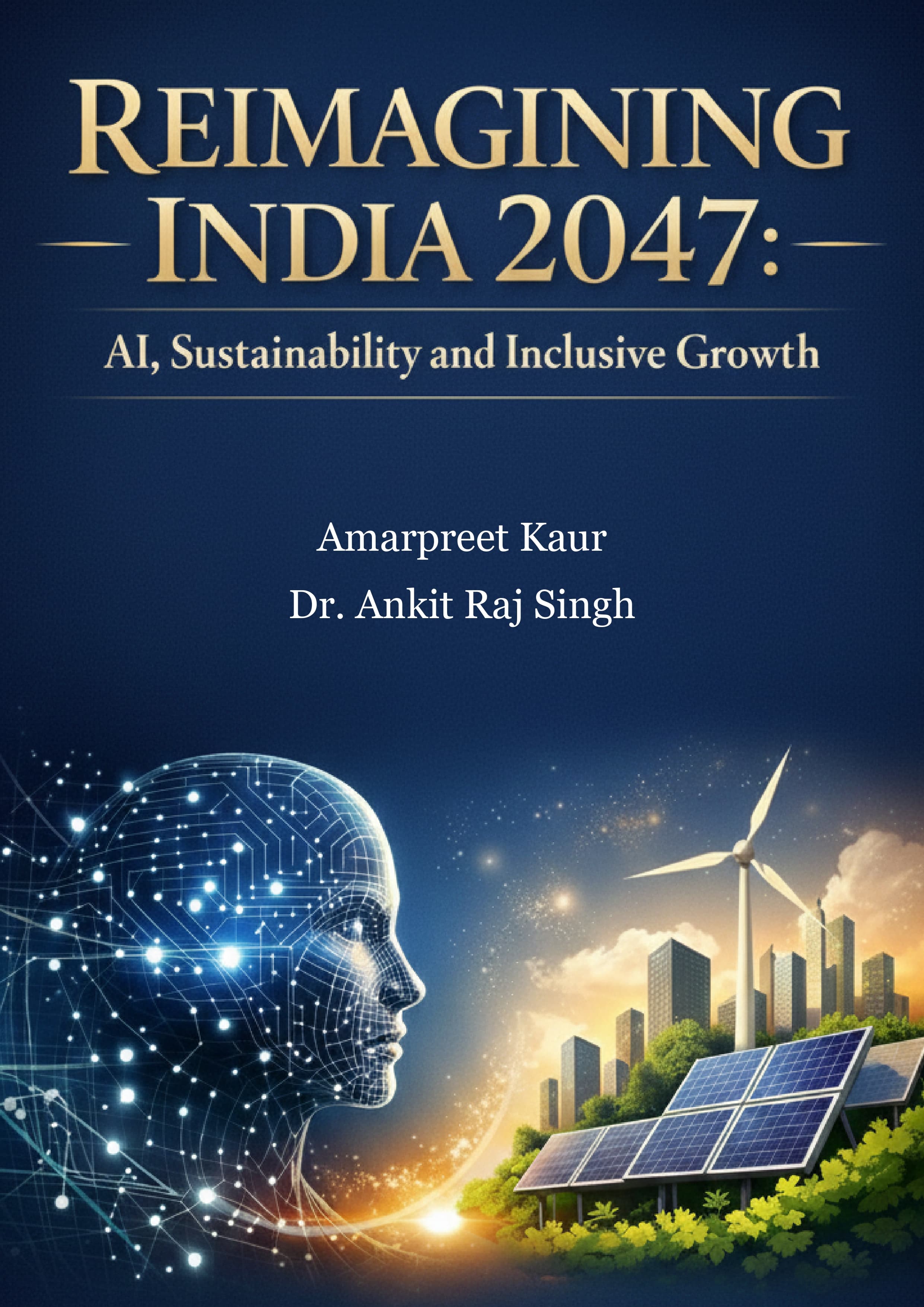
Authors: Amarpreet Kaur, Dr. Ankit Raj Singh
ISBN-13: 9789349554931
DOI: https://doi.org/10.5281/zenodo.18126855
Format: Paperback and e-book
Pages: 231
Product Dimensions: 6 x 9 inch
Publisher: Bharat Global Publications

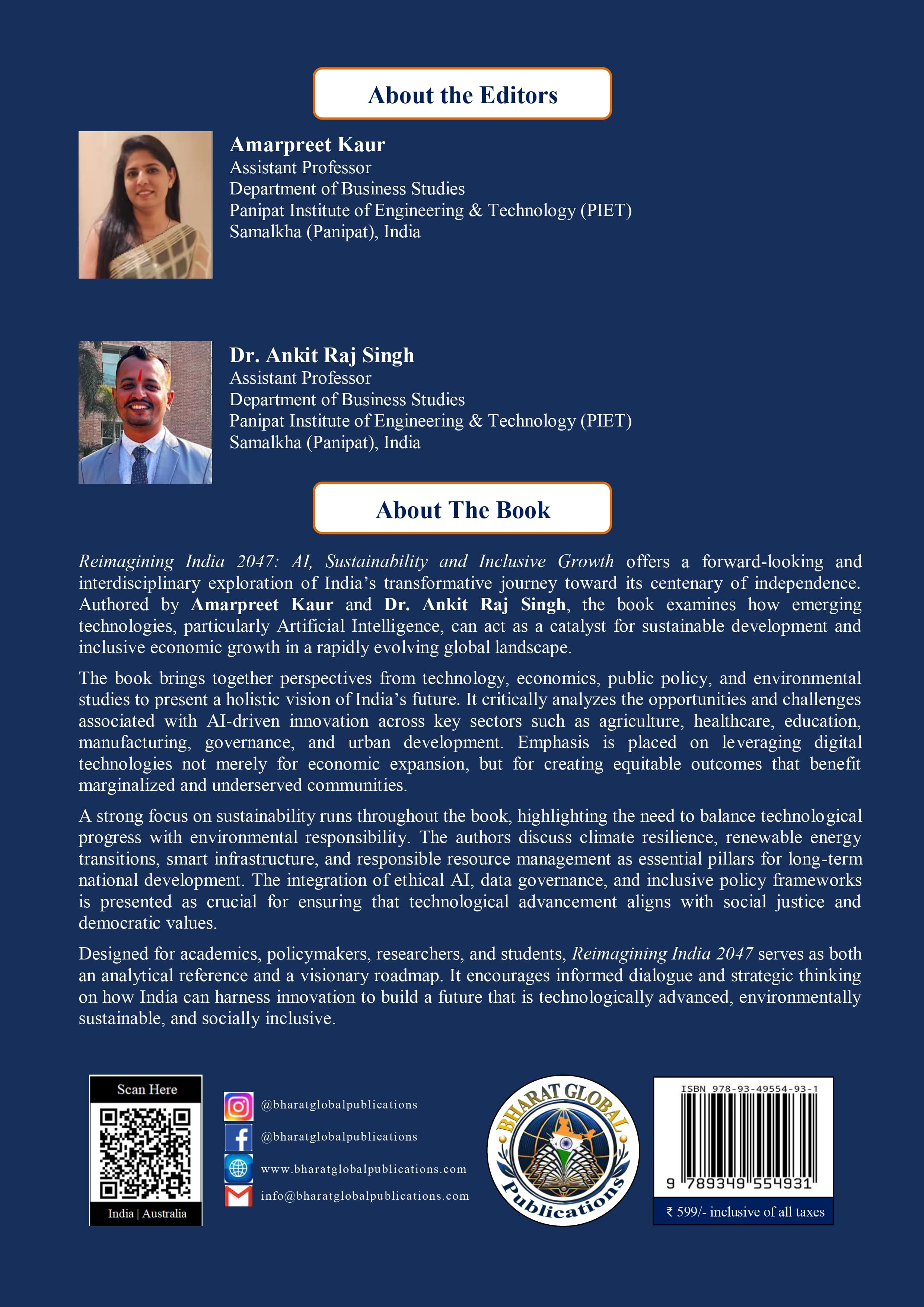
Amarpreet Kaur is an accomplished academic and researcher with over six years of experience in higher education. She is currently associated with the Panipat Institute of Engineering and Technology (PIET), Haryana, as an Assistant Professor. where she actively contributes to teaching, research, and academic development. Her academic interests lie in the areas of Finance and Marketing, with a strong focus on research-driven inquiry and contemporary issues in management studies.
She has made significant contributions to the research domain through publications in peer-reviewed journals and presentations at national and international conferences. Her scholarly work demonstrates a commitment to academic rigor, analytical depth, and relevance, contributing meaningfully to the body of knowledge in management and business studies.
Amarpreet Kaur has also held important academic and administrative responsibilities. She has previously served as an Academic Coordinator, contributing to curriculum planning, academic scheduling, and coordination of institutional academic activities. In addition, she has been actively involved in Enterprise Resource Planning (ERP) implementation and academic process management, supporting efficient administration and quality assurance.
She is a member of the Internal Quality Assurance Cell (IQAC) and the Summer Internship Committee, where she contributes to institutional quality enhancement, industry interface, and experiential learning initiatives.
As the editor of this book, she has played a key role in conceptualizing the theme, coordinating scholarly contributions, and ensuring academic coherence, consistency, and high editorial standards across the volume. Her editorial work reflects a strong commitment to advancing research-oriented academic discourse and scholarly excellence.

Dr. Ankit Raj Singh is an esteemed academician, researcher, and innovator with over a decade of experience across academia, industry, and research. He currently serves as Assistant Professor of Management at the Panipat Institute of Engineering and Technology (PIET), Samalkha (Panipat), where he teaches courses in Marketing, Brand Management, Corporate Social Responsibility, and International Trade.
He earned his Doctorate in Management from Sharda University, with a research focus on wellness tourism and consumer behaviour. Dr. Singh has published extensively in Scopus-indexed, ABDC-listed, and UGC Care journals, and has presented his work at numerous national and international academic conferences. He has also served as editor of several academic volumes in business and management studies.
With over six years of industry experience in the travel sector, Dr. Singh has contributed to corporate training programs for organizations like Hindustan Coca-Cola Pvt. Ltd. and Tata Power Solar India Ltd. An avid traveler, he has explored all 24 Indian states and 7 Union Territories, which informs his deep understanding of customer behaviour and service dynamics.
A staunch advocate for innovation and Intellectual Property Rights (IPR), Dr. Singh holds multiple design patents and copyrights granted by the Government of India. His research and teaching focus on wellness tourism, consumer behaviour, digital marketing, organizational change, and AI in management. He is actively guiding PhD scholars and postgraduate students in research and innovation projects.
Dr. Singh also holds several key leadership roles at PIET, serving as Chairman of the Placement & Summer Training Committee, and as a member of both the Research & Development Committee and the Internal Quality Assurance Cell (IQAC). He is also deeply engaged in community development through Rotary International’s CSR initiatives, including education, health, and environmental programs. His exceptional contributions have earned him recognition in social service activities, along with commendable service in Delhi Civil Defence.
Through his academic leadership, research innovation, and social commitment, Dr. Singh continues to shape the future of business management education across India and beyond.
Reimagining India 2047: AI, Sustainability and Inclusive Growth offers a forward-looking and interdisciplinary exploration of India’s transformative journey toward its centenary of independence. Authored by Amarpreet Kaur and Dr. Ankit Raj Singh, the book examines how emerging technologies, particularly Artificial Intelligence, can act as a catalyst for sustainable development and inclusive economic growth in a rapidly evolving global landscape.
The book brings together perspectives from technology, economics, public policy, and environmental studies to present a holistic vision of India’s future. It critically analyzes the opportunities and challenges associated with AI-driven innovation across key sectors such as agriculture, healthcare, education, manufacturing, governance, and urban development. Emphasis is placed on leveraging digital technologies not merely for economic expansion, but for creating equitable outcomes that benefit marginalized and underserved communities.
A strong focus on sustainability runs throughout the book, highlighting the need to balance technological progress with environmental responsibility. The authors discuss climate resilience, renewable energy transitions, smart infrastructure, and responsible resource management as essential pillars for long-term national development. The integration of ethical AI, data governance, and inclusive policy frameworks is presented as crucial for ensuring that technological advancement aligns with social justice and democratic values.
Designed for academics, policymakers, researchers, and students, Reimagining India 2047 serves as both an analytical reference and a visionary roadmap. It encourages informed dialogue and strategic thinking on how India can harness innovation to build a future that is technologically advanced, environmentally sustainable, and socially inclusive.